New research by the Alaska Department of Fish and Game has just been published, and sheds new light on what role deer play in wolf diets during denning season on Prince of Wales Island.
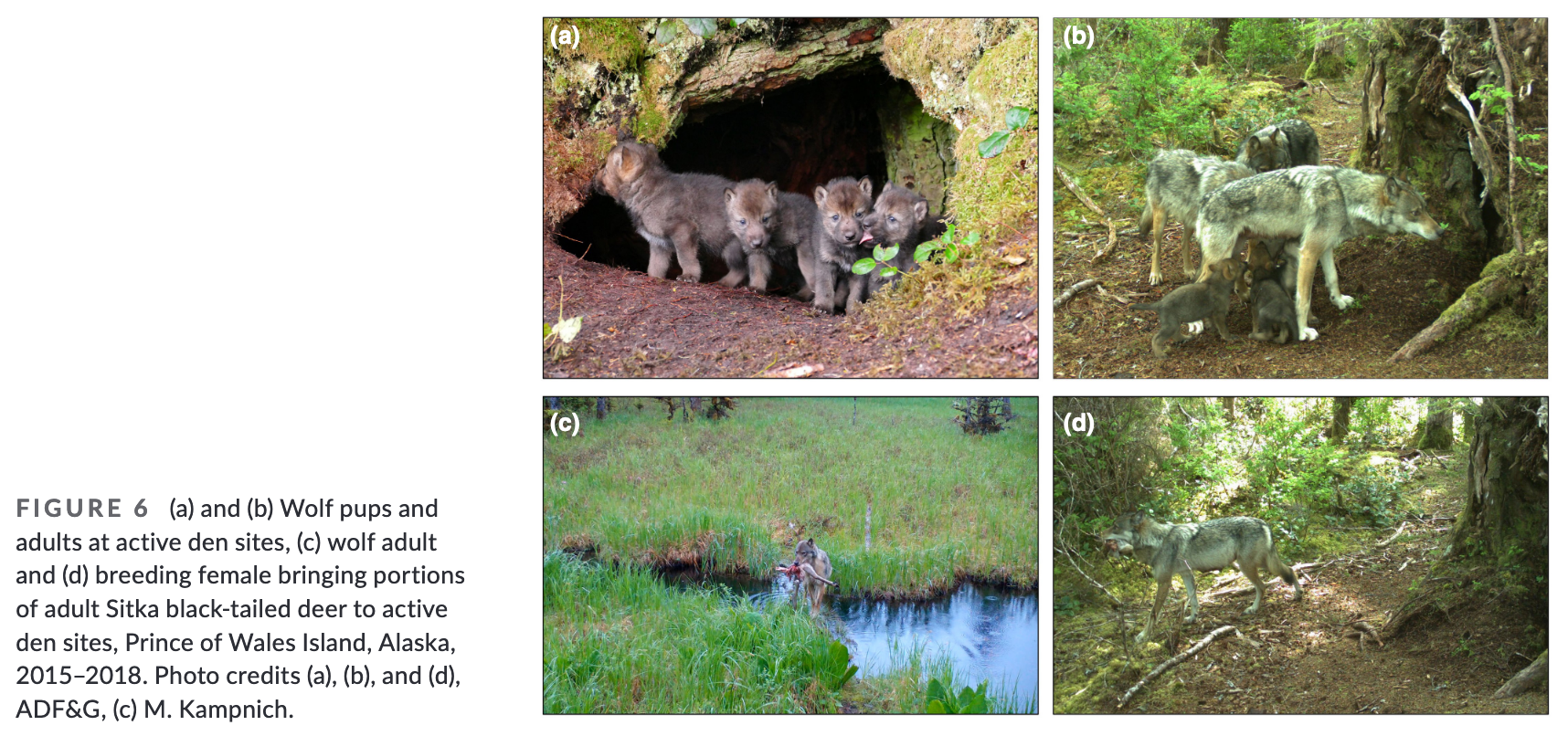
Deer was more common in wolf diets during denning season than other times of year, and pups ate a higher proportion of deer than adults.


Packs with more closed logging roads, more young clearcuts < 25 years old, and greater patchiness and variety of vegetation types also ate more deer during denning season and year round, and fed more deer to their pups. Pack and pup consumption of deer was linked to higher litter sizes of wolves. This is another angle on a dynamic that’s well established: that deer and wolf populations and their predator-prey relationship are deeply connected to forest habitat condition, including road density and density of young clearcuts.
What does all this mean for the future of wolves and deer on Prince of Wales? I’ll let the authors sum that up for themselves:
The benefits of early successional vegetation in young-growth forest to deer has a limited time frame post-logging, and deer abundance is predicted to decline as a greater proportion of the young-growth forests on POW move into the stem-exclusion phase (Alaback, 1982; Farmer & Kirchhoff, 2007; Person, 2001).
As deer are the primary prey of wolves on POW and in many areas of Southeast Alaska, this presents the question of whether wolves may be able to switch to other prey if deer were to become less available. Our recent work indicates that wolves in this region responded to lower dietary contributions of their primary ungulate prey by increasing the diversity of prey consumed (Roffler et al., 2021), suggesting wolves could tolerate large-scale ecological changes resulting in decreased abundance of deer.
Although wolves are highly adaptable and display dietary plasticity (Peterson & Ciucci, 2003), which is favorable to ensuring their persistence to environmental change and shifts in prey abundance and composition, other modeling efforts have pointed to how decreased deer habitat and abundance may be detrimental to wolf population growth rates and may trigger population declines (Gilbert et al., 2022; Person, 2001). Here we provide evidence of a possible adverse effect of deer declines to wolf fitness by linking the contribution of deer in wolf diets to litter size.
Although our sample size is limited, and further work would be valuable to gain a deeper understanding of the influence of habitat and prey availability on wolf population viability, we documented the prime importance of deer to components of wolf reproduction and fitness.
Our results suggest that one possible outcome of landscape-level reductions in deer habitat capability and abundance could be reduced wolf litter sizes and a corresponding decrease in the wolf population. However, considering the ample availability of alternate prey on POW, it is likely wolves would persist albeit at lower densities.